April 30, 2009

Citi Field - My First Visit

The Mets hosted the Marlins on a cool spring afternoon yesterday for my first visit inside Citi Field. Having seen it rise -- and its predecessor Shea Stadium fall -- I was eager to catch a game and sample the ambiance of New York's new home for National League baseball. First, a final farewell to Shea, as the last yards of its former footprint are leveled in preparation to being paved over.

Citi Field's most unique and most discussed twist is the main entrance lobby, the Jackie Robinson Rotunda. Along with outer facade of the ballpark, it is modeled after those at Brooklyn's hallowed Ebbets Field.WFAN colleague Mia Harris, on hand a couple of nights earlier, took the following shot peering down from the top.
While clearly built for baseball, Citi Field is not a snug or cozy as the east coast parks to which it'll be compared Camden Yards (Baltimore) or Citizens Bank Park (Philadelphia).
The stands flare away from the field more than you'd expect, or hope for. Especially upstairs (we sat in the middle 300 level), you don't have a sense of "being on top of the action."

While the Mets have usually been a franchise than emphasizes pitching over home runs, Citi Field might have gone too far. The outfield appears to be too spacious -- a la Petco Park in San Diego. We saw more hits dropping in front of outfielders than in the typical ballpark and certainly what we were used to at Shea.
(Below) Jorge Cantu was one of the Marlins batting stars. He's getting ready to connect on a home run off Mets ace Johan Santana.
Citi Field's outfield fences are high, including a left field a bit reminiscent of the Mets first home, the Polo Grounds. Here's where Cantu's homer landed in left field.
The grandstand that sweeps too far back from the field also results in too much foul territory. It's not Oakland-like, but it's far more than you remember from Shea.
The sense of spaciousness -- along with a heavier percentage of seating in the outfield changes your sense of proportion. Now the fans surround the action, instead of being behind it at Shea.
Below, the Pepsi porch (named for its sponsor) dominates the right field area. A clever idea, supposedly inspired by the grandstand in Detroit's now-gone Tiger Stadium. And below it, Modell's Mo Zone juts out to create a distinctive series of angles and corners for fielders to navigate and evade.
A ballpark can draw its personality from its players. Shea Stadium will always be symbolized by Tom Seaver, Tug McGraw, Jerry Koosman and Doc Gooden on the mound. Odds are the player whose scorecard position is "1" will remain the focus at Citi Field. Here's Mets ace Johan Santana in action:
He also shows fine form in a bunting situation.

April 29, 2009

Guess the Celebrity

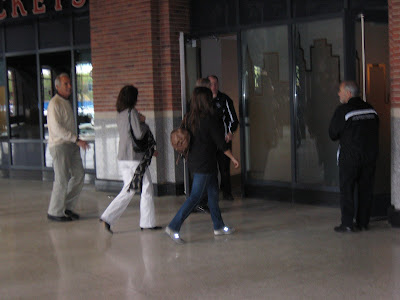
I made my first visit to the Citi Field today. While waiting in the Rotunda (lobby), I noticed some folks heading toward the smoked glass doors in the back. The gentleman in the off-white sweater caught the eye of several of us. Do you recognize him? Please leave your answer as a "Comment."

April 19, 2009

View from the Top


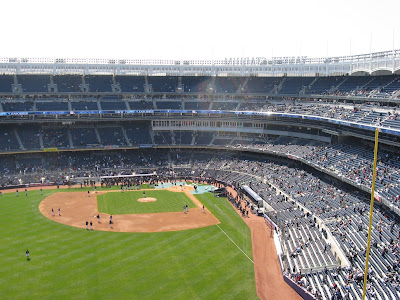
With all the comparisons of the new Yankee Stadium to its predecessor, I thought I'd offer up a view from the extreme -- the top of the left field grandstand in the new (top) and previous (below) ballparks.
It's one thing to tote the camera up for a few minutes of pre-game picture-taking. But would you want to see a game from all the way up? Have you ever done that at Yankee Stadium or anywhere else?

April 13, 2009

A Very Sad Day for Philadelphia

The Philadelphia Phillies lost their soundtrack today. For 38 years, Harry Kalas' expressive baritone was their signature voice. It heralded the club's renaissance under general manager Paul Owens in the 1970s. It was heard on each and every one of Mike Schmidt's 548 home runs. It brought home the word picture of the disappointment of playoff losses, the triumph of 1980 (except, due to contractual obligations, the World Series -- the first ever won by the club), the Wheeze Kids, "Lefty" Steve Carlton, the rowdy bunch that won again in 1993, a very disappointing dozen-year-long drought and a recent, magical revival.
Harry arrived in Philadelphia in 1971, as Veterans Stadium opened. The once state-of-the-art bowl was "the" place to be during the '70s, but over time aged badly, and by its 30th birthday was beginning to crumble. Harry and the ballclub moved into Citizens Bank Park in 2004.
And fortunes slowly but surely improved -- a fan-friendly home, a likable young core of stars and last October, Harry was on the radio to call the action, including its dramatic conclusion, for the home faithful.

Paired with beloved former Phillies center fielder Richie Ashburn, they formed one of baseball's best broadcast duos for 27 seasons -- two pals who enjoyed sharing a microphone, talking baseball, talking life -- a partnership that ended with Ashburn's sudden death in New York during a road trip late in the '97 season. And today, just prior to the Phils/Nationals game in Washington came an equally shocking bulletin -- Harry collapsed preparing for the game. He was 73.
A broadcaster is sometimes considered a shill for the club. A pitchman. A carney to lure you into a show. Harry was never that. He and Rich took pride in their honestly. When the Phighting Phils were successful, they gave proper credit. But when the club was "scuffling," as Ashburn was heard to say in tougher times, they refused to gloss things over -- earning the trust of Phillies fans. Need proof? Ashburn, the speedy centerfielder from Nebraska who then spent three-and-and-a-half decades behind a Philadelphia microphone was arguably the most popular personality in franchise history. The centerfield concourse at Citizens Bank Park is named for him.
His statue is prominently displayed on Ashburn Alley.

One of the ballpark's restaurants, Harry the K's, is named for Kalas.

Harry Kalas was the resonant voice that symbolized spring and summer during the most successful era for the losingest franchise in pro sports history. Happily, he called the championship run of 2008 and got to ride a float -- he's in a grey sports jacket about five people to the right of the Phantic -- in the parade that followed the clincher.
As 2009 began, after a pair of opening defeats, things were looking up -- Sunday's game in Colorado was a come-from-behind victory. It was also the finale of his Hall of Fame career. Today's game, also a Phillies win, was called by Harry's colleagues in his memory. As they will the remainder of this season.

The voice that resonated like the Liberty Bell just won't be there to paint the word picture again.

April 2, 2009

Yankee Stadium - The First Event

Dennis and I were on hand for Yankee Stadium's first public event, a pre-season workout. Crossing 161st Street in the Bronx, the entrance is certainly imposing. While not promoting its "lobby" the way the Mets have, this gallery of greats on banners from a soaring ceiling certainly stands in contrasts to the old park's cramped, subway station-like entrance.
Finally, a look at the field and the stands. The visual effect is remarkable. All the cues -- the colors, the architecture, the placement of distinctive features -- instantly say "Yankee Stadium."
No team does a better job of selling its history. Glossy, historic panoramas are displayed prominently on the main level. Babe, the Mick, Joe D and Thurman will greet you as you head for a hot dog, beer and a souvenir.
So similar to the post-renovation Stadium's right field corner, the new version brings the bleachers closer and then wraps a new field level section in front of them.
For some, a cap, tee shirt or coffee mug is not enough. Peter Max's artwork has its own store at the new Stadium.
Back to the field...
If you had trouble recognizing this strong righthander on the mound, the world's largest video board will help.
A tip of the cap to the original Yankee Stadium comes in the form of the scoreboards mounted in the Right-Center and Left-Center Field fences.
Spanning present and past -- the atrium's portholes offer a poignant look back at the old Stadium, just across 161st Street.
From the upper deck, a sparkling spring day and the wide outfield expanse.
Oh yes, the workout... the players assemble in right field.
And Freddy's back! New stadium, same fry pan. A view from the new field-level seats in Left Field. Stunning how the new Stadium so resembles the original stadium pre-1973 renovation.The frieze, that distinctive moulding fringing the Stadium's roof reminds you again of the way it was and is again. Monument Park is now behind the centerfield wall, just beneath the smoked glass window of a sports bar serving as the batter's eye.
Derek Jeter's in the batting cage, taking his first swings at his new home.
And getting a good look at where it lands.
We'll leave you at the top -- from the upper row of the Left Field Grandstand.
The result is very impressive -- after walking around the entire park, I was impressed by how the architects did a superb job of recreating the grandeur of the pre-'73 original Stadium, while bringing almost all the seats closer (having a fourth level of stand enabled the other three levels to be less deep). Aisles are wider, legroom more spacious... and the areas behind the seats, leading to the concessions and restrooms are open and airy, similar to the way they are in many newer parks. Sure, it cost a mountain of money. But no corners were cut or designs compromised. Costs aside, this is going to be an even better place to see a game than its post-renovation predecessor across the street.

If you'd like to do an A/B comparison to the pre-renovation Stadium, check this post of mine: http://mikemccann.blogspot.com/2008_08_01_archive.html